
On Thursday, May 30, 2024, I walked from my hotel to the Radius Tours Office and got on a large motor coach bus for a 75 mile, 1.5 hour bus ride for a Neuschwanstein Castle Tour, in Schwangau, Bavaria, Germany, within the foothills of the Alps.
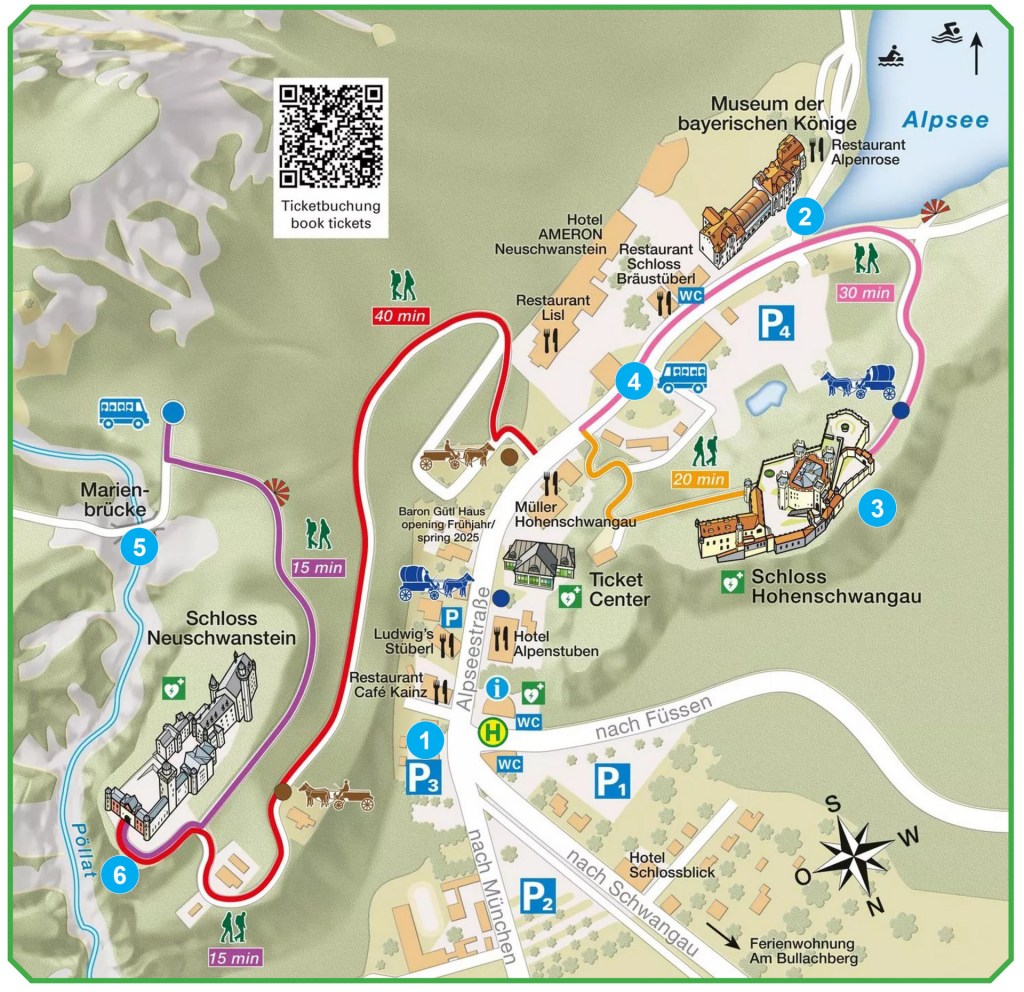
How to reach the Marienbrücke (Mary’s bridge).
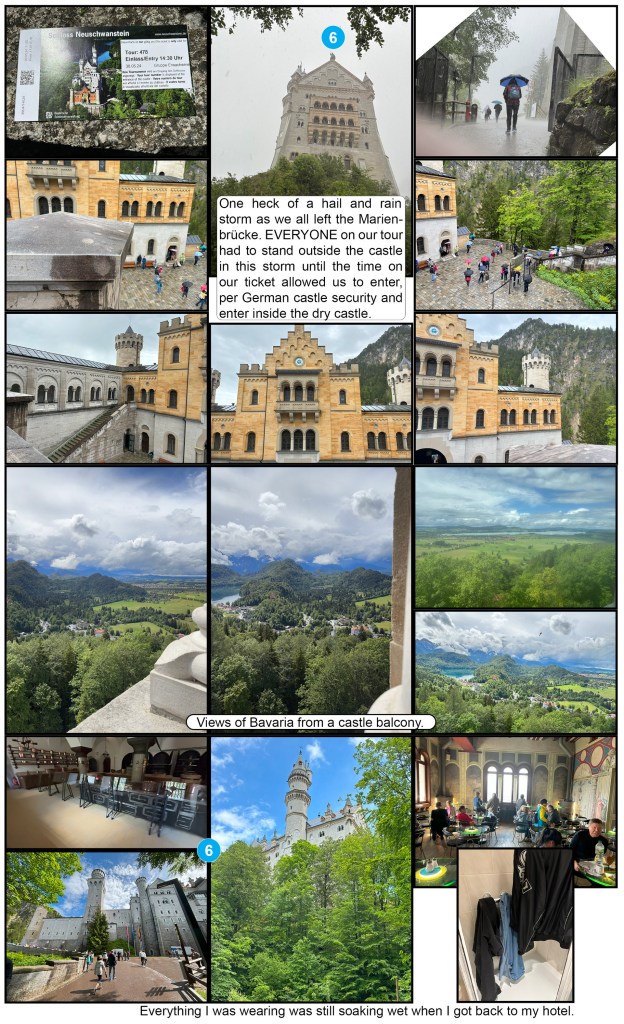
After our walking tour of Schwangau we were told to meet at the Neuschwanstein Castle at 2:30 PM. And, suggested we stop at the Marienbrücke for great photos of the Neuschwanstein Castle. We could either walk uphill on a steep incline for 45 minutes to the bridge, or take a horse-drawn carriage or a 15 minute Shuttle Bus for €5.00 ($5.45) per person, round trip from parking lot P4. Virtually all of us took the bus!
But, when retuning the very curvy road was too dangerous for the Shuttle Bus to drive on, from all the hail and rain! I had been told there was even a steeper shortcut down the hill to our motor coach bus, which I found and transited without falling!
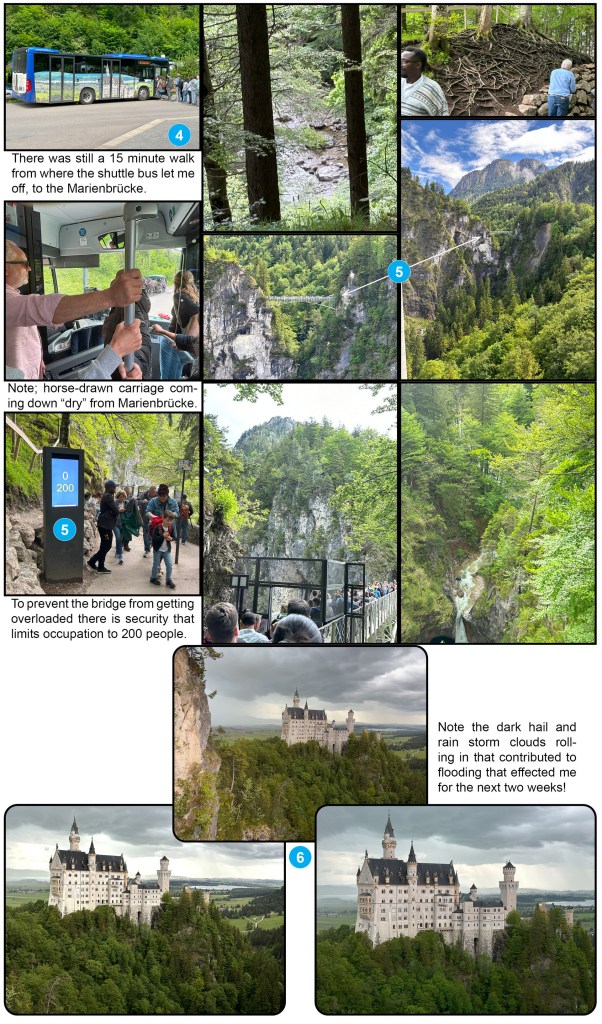
Marienbrücke (Mary’s bridge), above the Pöllat Gorge.
Marienbrücke (English: Mary’s Bridge, aka Pöllat Bridge) is situated right behind and in clear line of sight of the Neuschwanstein Castle. The bridge was named after Queen Marie.
In 1845, King Maximilian II, ordered a wooden footbridge to be built across the Pöllat Gorge. This bridge was constructed using traditional timber construction and most likely turned out to be not very stable, since it was rebuilt after only a few years. In order to increase the bridge’s stability, a structure consisting of three layers of beams and lateral support beams was chosen. The resulting building, stretching to 115 feet in length, however, it did not offer an aesthetically pleasing sight of the Neuschwanstein Castle.
Precisely this was why King Ludwig II’s reason to have this footbridge replaced by a filigree iron structure in 1866. During the construction of Marienbrücke Bridge, a completely new method of construction was successfully tested: At a distant of 300 feet above the Pöllat cascade, the girders were erected by anchoring it in rocks on both sides by pre-constructing the individual support frames, without requiring further supportive braces.
In 1984, the bridge was restored with the girders being renewed again. The barristers, however, are still the original ones used in 1866.
In early August 2015, the bridge was temporarily closed for visitors, due to restoration work on the rock anchoring system. Damaged anchors were repaired, and the coatings of the iron structure and the wooden floorboards were also renewed.
From the beginning of 2021 to the middle of 2022, the Marienbrücke was closed again, because all rock anchors had to be replaced due to structural problems. “Rest assured, I felt this spindly bridge was safe to walk on, with occupation limits!“

Copyright @ 2024 JACK L. WINEGAR All Rights Reserve.
 Jack's Travel Blog